
No. 79:Ms. Huang Xiaoyu (Tohoku University, completed AELC in November, 2025)
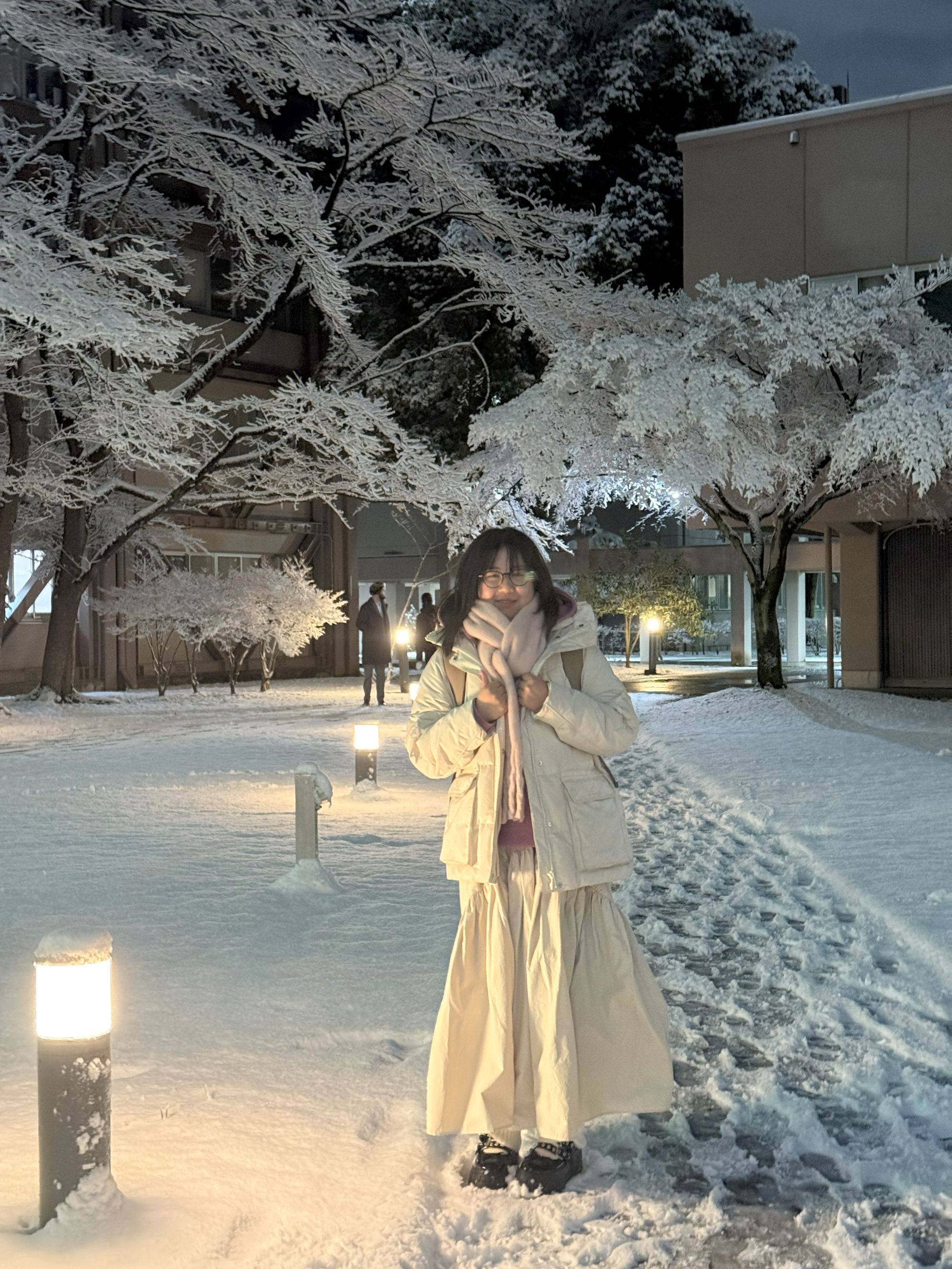
Participating in the Asia Education Leader Course (AELC) twice (2024 winter course at Nanjing Normal University and the 2025 summer course in Korea University) has been one of the most meaningful learning experiences in my first-year doctoral journey. If I had to summarize my biggest takeaway in one sentence, it would be this: AELC helped me see East Asian education not as an abstract “region,” but as a living network of people, classrooms, and stories. It made me want to become someone who can connect those dots with both professional knowledge and human understanding.
First, I gained friendships that I believe will last far beyond the two-week program. Learning alongside students from different countries and regions gave me a rare kind of daily intimacy: we studied together, struggled with the same assignments, and kept talking long after class ended. These friendships were not simply “international connections.” They became a mirror that reflected my own assumptions. I started noticing how quickly I label certain practices as “normal,” when in fact they are shaped by my own educational background.
Second, AELC allowed me to experience how different educational environments operate in context. In just two weeks, I was able to learn from outstanding instructors from various universities and also generate ideas through group discussions with peers. One teacher who deeply influenced me was Prof.Chen from Nanjing Normal University. In only three days, she made me genuinely understand the appeal of quantitative research using SPSS. What stayed with me even more was our conversations outside the classroom, during dinner and coffee. Through her words and the way she carries herself, I realized how important it is for a university teacher to protect their attention and integrity: to focus on research, teaching, and student development, and to avoid distractions that pull you into unnecessary trouble. She became a model for me of what a good professor can look like.
Third, AELC reminded me that honest dialogue is possible even across sensitive differences. During one group discussion, our instructor asked everyone to type answers onto a shared screen. Someone suddenly uploaded a national flag, and then many others joined, including students from Mainland China, Japan, Korea, Taiwan, and Macau. That small moment felt surprisingly powerful. It did not erase political differences, but it created a space where we could talk openly, reduce misunderstandings, and see each other as real people rather than stereotypes. Even a simple topic like “involution” (competitive pressure) became richer: we discovered that everyone feels pressure, but the “style” and structure of pressure can be very different across systems.
Finally, the school visits turned comparative education into something concrete. In Korea, we visited an autonomous private high school (자율형사립고). Before the visit, I had little knowledge of this type of school. Seeing it in person, especially the courses designed for high-achieving students, was eye-opening. We observed a small advanced math class where students presented with PPT, introducing mathematical models I had never encountered before. It made me reflect on how talent development is organized differently across contexts, and how “equity” and “excellence” are negotiated in each system.
Going forward, I hope to link these experiences directly to my future goals. AELC aims to nurture internationally minded educational professionals who can conduct comparative analysis and collaborate across East Asia. After these two programs, that goal feels personal to me. I want to strengthen my ability to compare education systems with nuance, while also staying grounded in relationships and real educational settings. In the future, whether I work as a researcher, teacher leader, or education administrator, I hope to carry the spirit of AELC with me: learning across borders, speaking honestly, and building collaborations that are both intellectually serious and deeply human.