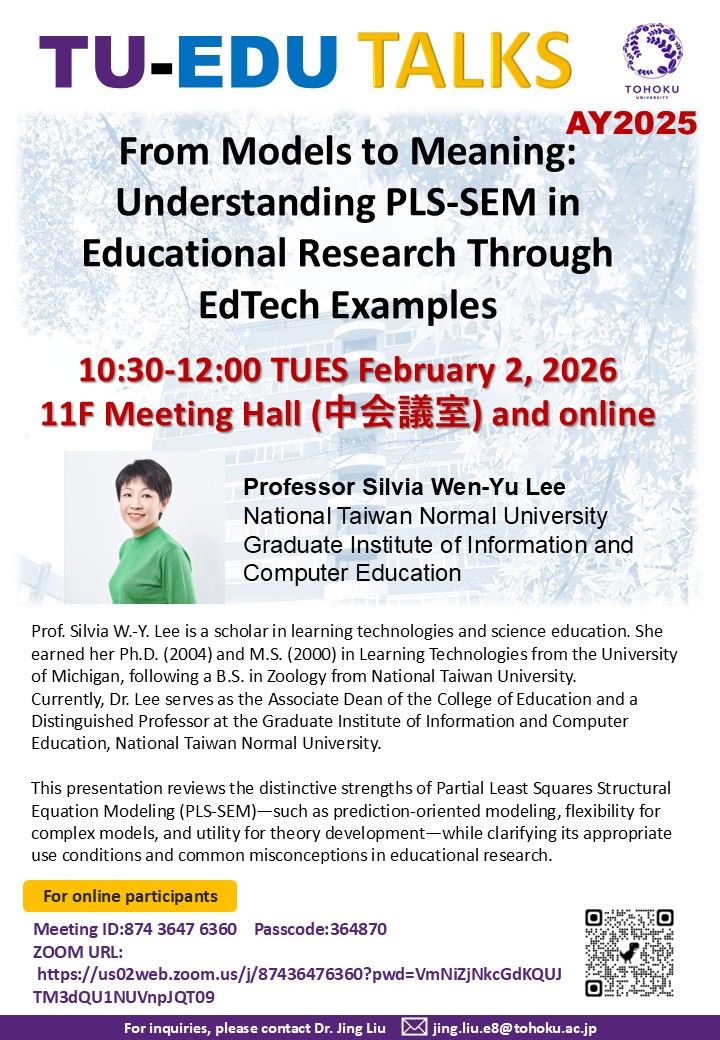
We are pleased to announce the 7th TU-EDU Talks of Academic Year 2025 to be held on February 2, 2026 (10:30-12:00).
You are welcome to join us either onsite or online.
Time: 10:30-12:00, February 2, 2026
Venue :
◆ Onsite: 11F Meeting Room(中会議室) Graduate School of Education, Tohoku University
◆ Online: ZOOM URL: https://us02web.zoom.us/j/87436476360?pwd=VmNiZjNkcGdKQUJTM3dQU1NUVnpJQT09
Meeting ID: 874 3647 6360
Passcode: 364870
About the speaker:
Prof. Silvia W.-Y. Lee is a scholar in learning technologies and science education. She earned her Ph.D. (2004) and M.S. (2000) in Learning Technologies from the University of Michigan, following a B.S. in Zoology from National Taiwan University.
Currently, Dr. Lee serves as the Associate Dean of the College of Education and a Distinguished Professor at the Graduate Institute of Information and Computer Education, National Taiwan Normal University. Her international experience includes a visiting scholarship at Michigan State University and a research scientist at the American Institutes for Research in Washington, DC.
Dr. Lee’s recent research projects and interests focus on virtual reality in education, computer-supported science learning, STEM education and computational thinking. She is the Editor-in-Chief of Educational Technology & Society and an Associate Editor of Research in Science Education. Her contributions have been recognized with prestigious awards, including the Outstanding Research Award from the National Science and Technology Council (2025).
Presentation abstract:
This presentation reviews the distinctive strengths of Partial Least Squares Structural Equation Modeling (PLS-SEM)—such as prediction-oriented modeling, flexibility for complex models, and utility for theory development—while clarifying its appropriate use conditions and common misconceptions in educational research. Particular attention is given to research questions well suited to PLS-SEM and to the relationships between theories and models. To make these issues tangible, I draw on illustrative examples from my educational technology research, including studies on virtual reality, game-related learning contexts, and survey investigations. These cases demonstrate how PLS-SEM findings can yield meaningful implications for educational practice and research.