Passcode: 364870
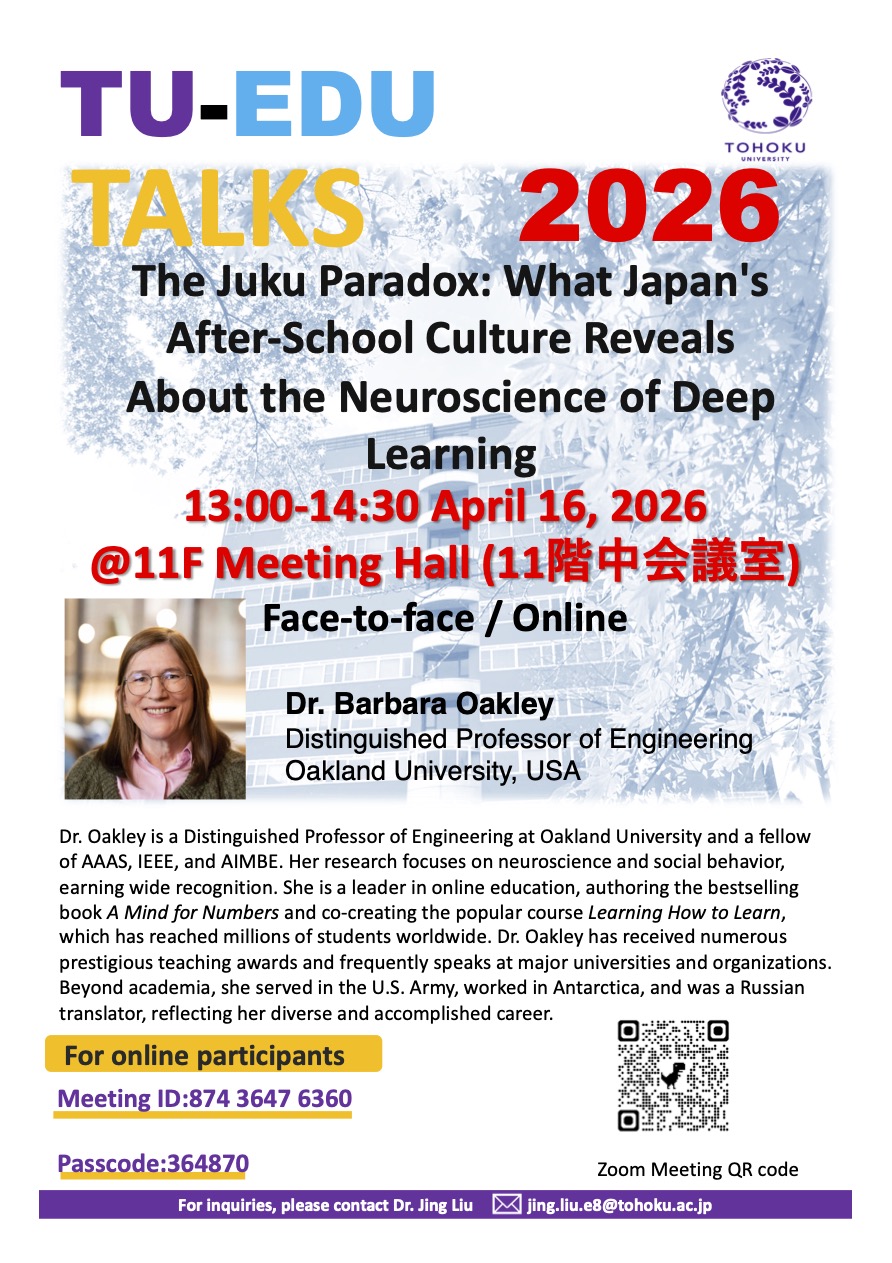
Dr. Oakley is a Distinguished Professor of Engineering at Oakland University and a fellow of AAAS, IEEE, and AIMBE. Her research focuses on neuroscience and social behavior, earning wide recognition. She is a leader in online education, authoring the bestselling book A Mind for Numbers and co-creating the popular course Learning How to Learn, which has reached millions of students worldwide. Dr. Oakley has received numerous prestigious teaching awards and frequently speaks at major universities and organizations. Beyond academia, she served in the U.S. Army, worked in Antarctica, and was a Russian translator, reflecting her diverse and accomplished career.
Japan presents a puzzle that education researchers rarely examine directly: why do students so often learn more in juku than in school? The answer, this talk argues, is not cultural but neural—and it has urgent implications for education systems worldwide.
Drawing on her latest research, Barbara Oakley takes audiences inside the learning brain to explain what deep learning actually requires at the level of neural architecture. She traces the critical shift from declarative to procedural memory—the movement from effortful, conscious recall to fluent, automatic expertise—and explores how this transition depends on processes now being illuminated by AI research, including "grokking," the sudden emergence of genuine generalization after extended practice, and "distillation," the compression of dense knowledge into elegant, flexible representations. These are not metaphors: they are neural phenomena, and they require exactly what juku reliably provide and many school classrooms increasingly do not—explicit instruction, ample practice, and the internalized knowledge that makes prediction errors possible.
This leads to the central paradox: in an era when AI can instantly supply any answer, the knowledge students carry in their own heads matters more than ever. The brain's most powerful learning mechanisms—schema formation, prediction error signaling, the declarative-to-procedural shift—all depend on internalized knowledge to function. Outsource that knowledge to a screen, and the engine stalls.
Oakley situates these findings within a broader argument: that constructivist pedagogy functions as a practically non-falsifiable paradigm, and that an alternative framework—cognitive realism, grounded in how brains actually encode, consolidate, and retrieve information—offers a corrective. The juku, whatever its limitations, turns out to be an accidental experiment in cognitive realism. The question for researchers and policymakers is whether schools can learn from it before another generation pays the price.