1. Research Purpose
In recent years, multiple and interconnected crises—including climate change, large-scale disasters, pandemics, and environmental degradation—have become increasingly apparent, prompting a fundamental reconsideration of the modern development paradigm that has underpinned the Sustainable Development Goals (SDGs). At the International Education Development Forum (IEDF) 2025, Professor Iveta Silova argued that “the current crisis is not a lack of knowledge, but an inability to unlearn existing assumptions,” thereby highlighting the need for Unlearning Development. At the same time, the concept of disaster culture has attracted growing attention in Japan since the Great East Japan Earthquake. Existing studies of disaster culture have emphasized the transmission of disaster knowledge, collective memory, and community formation as cultural foundations that support social resilience. However, relatively little attention has been paid to how disasters challenge the very foundations of modern development thinking and what they compel people to unlearn.
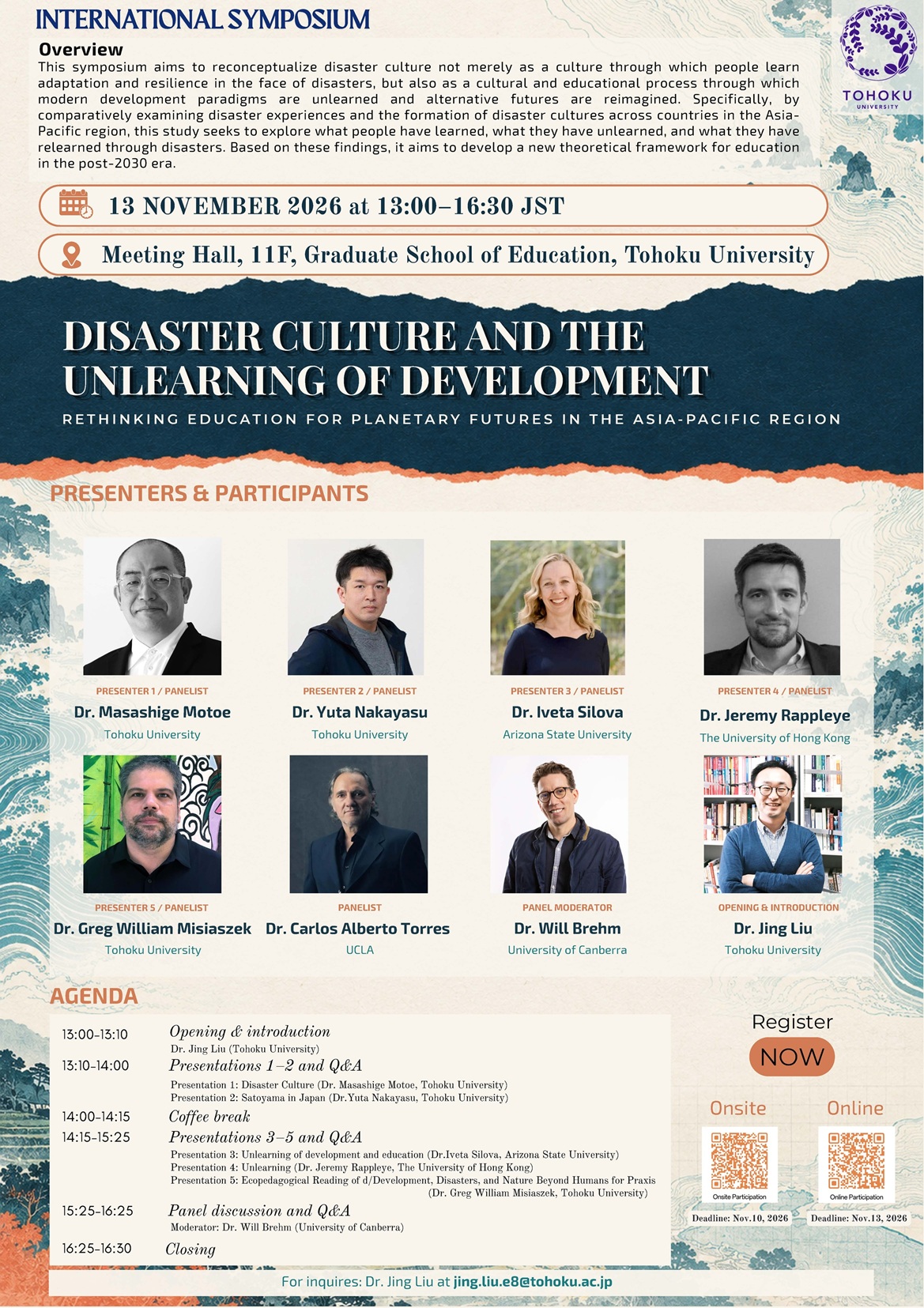
This study aims to reconceptualize disaster culture not merely as a culture through which people learn adaptation and resilience in the face of disasters, but also as a cultural and educational process through which modern development paradigms are unlearned and alternative futures are reimagined. Specifically, by comparatively examining disaster experiences and the formation of disaster cultures across countries in the Asia-Pacific region, this study seeks to explore what people have learned, what they have unlearned, and what they have relearned through disasters. Based on these findings, it aims to develop a new theoretical framework for education in the post-2030 era.
2. Significance of the Research
Whereas conventional disaster culture studies have primarily asked the question, “What can we learn from disasters?”, this study shifts the focus to a different question: “What do disasters compel us to unlearn?” Its significance lies in examining disaster culture not simply as a culture of disaster preparedness or resilience, but as an educational and cultural process through which modern development paradigms are critically questioned and the relationships among humans, society, and nature are reimagined.
By redefining disaster culture in this way, the study seeks to provide a new theoretical foundation for education and sustainable futures in the post-2030 era. It contributes to ongoing debates on educational transformation, sustainability, and societal resilience by highlighting the role of disasters as catalysts for unlearning dominant assumptions and envisioning alternative pathways toward more just, sustainable, and resilient futures.
3. Agenda
|
13:00-13:10 |
Opening & Introduction: Dr. Jing Liu (Tohoku University) |
|
13:10-13:30 |
Presentation 1: Disaster Culture (Dr. Masashige Motoe, Tohoku University) |
|
13:30-13:50 |
Presentation 2: Satoyama in Japan (Dr.Yuta Nakayasu, Tohoku University) |
|
13:50-14:00 |
Q&A |
|
14:00-14:15 |
Coffee Break |
|
14:15-14:35 |
Presentation 3: Unlearning of development and education (Dr.Iveta Silova, Arizona State University) |
|
14:35-14:55 |
Presenataion 4: Unlearning (Dr. Jeremy Rappleye, The University of Hong Kong) |
|
14:55-15:15 |
Presentation 5: Ecopedagogical Reading of d/Development, Disasters, and Nature Beyond Humans for Praxis (Dr. Greg William Misiaszek, Tohoku University) |
|
15:15-15:25 |
Q&A |
|
15:25-16:10 |
Panel discussion |
|
Moderator: Dr. Will Brehm (University of Canberra) |
|
|
Panelists |
|
|
Dr. Masashige Motoe (Tohoku University) |
|
|
Dr. Yuta Nakayasu (Tohoku University) |
|
|
Dr. Iveta Silova (Arizona State University) |
|
|
Dr. Jeremy Rappleye (The University of Hong Kong) |
|
|
Dr. Greg William Misiaszek (Tohoku University) |
|
|
Dr. Carlos Alberto Torres (UCLA) |
|
|
16:10-16:25 |
Q&A |
|
16:25-16:30 |
Closing |
Registration
Onsite Participation https://forms.gle/aUbHzQoXtg91YiqB9 (Deadline: Nov.10, 2026)
Online Participation https://us02web.zoom.us/meeting/register/Vqybp3I5RqK4XSCM1NCjcg (Deadline: Nov.13, 2026)
Venue:
Meeting Hall, 11F, Graduate School of Education, Tohoku University